Midterm Deliverable: Porting Safeclib to RTEMS, Multi-Arch Recipes, and SPARC Bug Hunting
As part of my Google Summer of Code (GSoC) 2026 journey with the RTEMS Project, my midterm objective was clear: cross-compile the C11 Annex K Bounds Checking Library (safeclib) for RTEMS, seamlessly integrate it into the RTEMS Source Builder (RSB), and validate it on bare-metal architecture.
What sounded like a straightforward porting task quickly evolved into a deep dive into cross-compilation quirks, dynamic build configurations, and debugging strict-alignment hardware exceptions on the SPARC architecture.
In this post, I will break down exactly how I patched the library, conquered the RSB, and validated the test suite in the SPARC simulator, documenting every pitfall so future developers can navigate them easily.
Challenge 1: Architecture Independence (The Patch)
The first major hurdle was the “multilib” problem. The safeclib source code relied heavily on hardcoded compiler checks (like sizeof(uint32_t)) that inherently break when cross-compiling for different architectures.
The Fix: I created a C patch to rip out those hardcoded checks and replace them with dynamic GCC macros (like __SIZEOF_POINTER__). This ensures the library is truly architecture-independent and adapts at compile-time to whatever target RTEMS requires.
Challenge 2: Taming the Build System (The RSB Recipe)
Writing the RSB .cfg recipe required bypassing several unique build system bugs and bare-metal traps:
- The Git Extraction Bug: The RSB initially refused to clone the source properly. The Fix: I forced the RSB to unpack the code by explicitly appending
?checkout=master?pull=1to the source URL. - The Symlink Bug: RSB had a hidden bug where it failed to define the source directory, breaking the build pipeline. The Fix: I bypassed this by manually injecting
source_dir_safeclib="rtems-safeclib"into the%prepphase. - The Bare-Metal Compiler Trap:
safeclibaggressively tried to enforce Linux-style Stack Smashing Protectors (ssp.h) and strict GCC warnings. The Fix: I injected custom bare-metal override flags (-U_FORTIFY_SOURCE -fno-stack-protector -Wno-error) into theCFLAGSduring the./configurestep.
Challenge 3: Dynamic Multi-Architecture Support & Linker Errors
To make the recipe robust for the RTEMS ecosystem, it needed to support cross-architecture builds out of the box (MR !269).
- Dynamic
pkg-config: I replaced the hardcodedrtems-bspsplaceholder with dynamic host/bsp extraction (%{_host}-$(basename %{with_rtems_bsp})) during the%buildphase. This allowspkg-configto correctly extract compilation flags for any target architecture (SPARC, RISC-V, etc.). - Bypassing the Syslog Linker Error: On bare-metal targets, linking the performance tests failed entirely due to an undefined reference to
syslog—a utility that simply doesn’t exist on these lightweight embedded targets. The Fix: I usedsedto strip thetestsdirectory from the generated Makefile targets. This prevented the broken test suite from interrupting the build while ensuring the core library, headers, and.pcfiles installed correctly.
The First Milestone: Minimal Proof of Execution
With the library successfully building, the initial test was to link it against a basic bare-metal RTEMS application to verify the hooks.
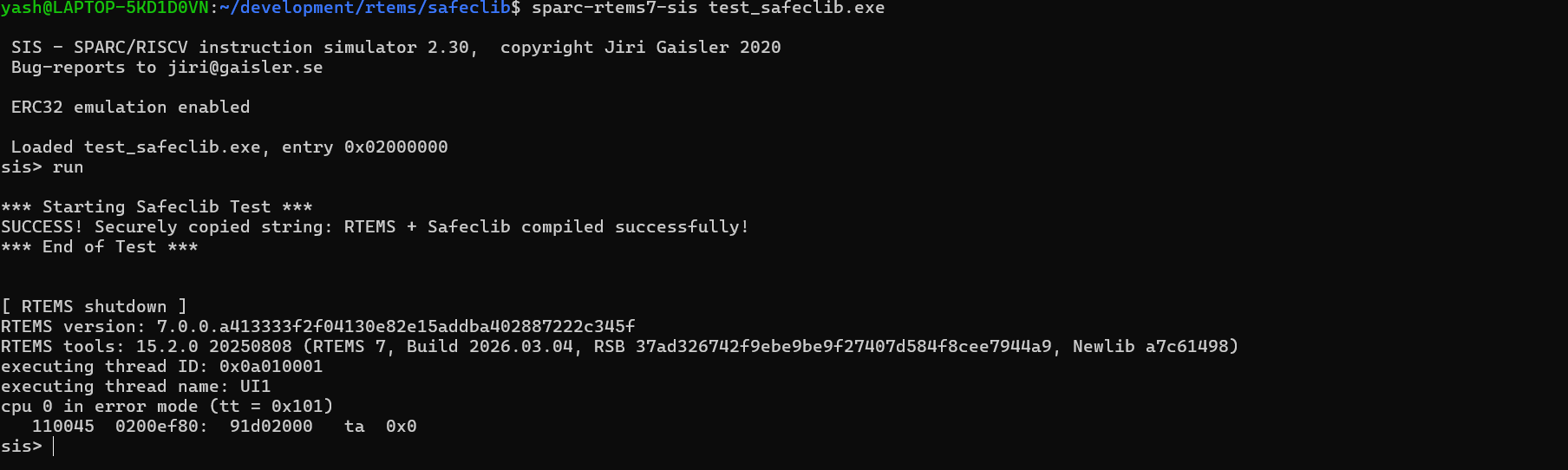
I wrote a minimal RTEMS initialization task that invokes the strcpy_s (secure string copy) function from my newly compiled static library. Running it in the SPARC Instruction Simulator (sparc-rtems7-sis) yielded a clean execution:
The Final Boss: Full Test Suite Validation
With basic execution proven, the final step was running the entire safeclib test suite on the simulator. This is where the real bare-metal debugging began.
Initially, the test suite threw catastrophic OS-level crashes. I had to debug and apply two critical OS-level fixes to my RTEMS initialization task:
- FPU Exceptions (Code 38): The simulator was crashing due to illegal floating-point unit usage. The Fix: I injected the
RTEMS_FLOATING_POINTattribute into the Init task. - File Descriptor Exhaustion: The library’s
fopentests were crashing the OS because RTEMS defaults to a highly restrictive file descriptor limit. The Fix: I bumpedCONFIGURE_MAXIMUM_FILE_DESCRIPTORSup to 32.
The Result: 116 PASS and Hardware Bug Hunting
Once the OS configurations were patched, the test suite results immediately jumped to 116 PASS.
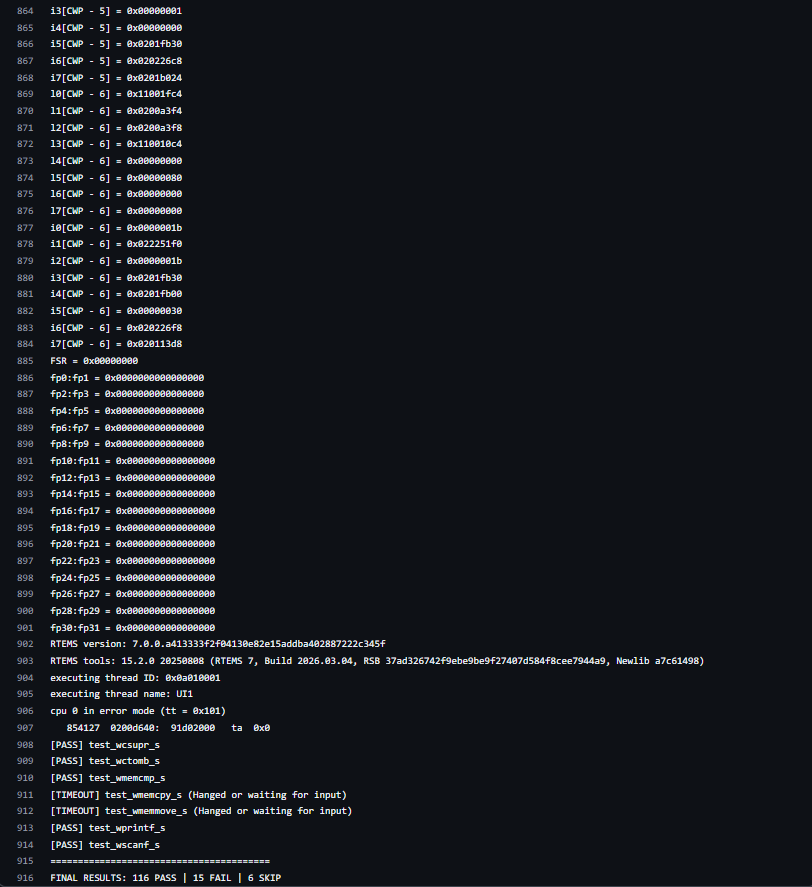
More importantly, clearing away the OS crashes isolated the remaining 15 Fails and 6 Timeouts (in functions like test_memcpy32_s and test_mbstowcs_s). As suspected, these are not OS errors, but genuine SPARC strict-alignment data access exceptions (Trap 9s) and infinite loops.
Standard x86 desktop processors often hide these memory alignment flaws, proving exactly why validating this library on strict bare-metal architectures like SPARC is so critical. I am currently documenting these isolated hardware traps to file as upstream bug reports to the safeclib maintainers.
With the library ported, dynamically compiling across architectures in the RSB, and the SPARC validation complete, my midterm deliverables are officially wrapped. Next up: building the riscv-rtems7-gcc toolchain and seeing how RISC-V handles these exact same memory alignment tests!